Vice President JD Vance stood at a podium in Middletown, Ohio last week and told a story: a computer programmer named Kevin Flanagan, ordered to train the foreign worker who would replace him just to collect his own severance — who went to work, finished the job, walked to his truck, and killed himself.
Within a day, the story had done what these stories usually do online: it became a fight about tone. Columnist John Podhoretz responded by asking, sarcastically, what explains “the 2 billion other people” who face career setbacks and don’t take their own lives. Donald Trump Jr. fired back, framing the dismissal as proof of “soulless globalism.” By Saturday afternoon the tweet had close to half a million views, and the actual policy question — the one that should be the story — had mostly disappeared into a personality fight on Twitter/X.
We’re not interested in re-litigating who was ruder to whom. We’re interested in the thing that keeps getting lost every time this happens: the practice at the center of the story is real, it’s legal, and it happens constantly.
The training-your-replacement pipeline is not a myth
Search our H-1B databases for any given year and you’ll find thousands of Labor Condition Applications tied to IT and back-office roles at banks, insurers, and Fortune 500 firms — filed by staffing and consulting firms that specialize in exactly this transition: bring in visa labor, have the outgoing American employee document their own job during the handover period, then let the position go. It’s been documented in Congressional testimony, in Department of Labor disclosure data, and in firsthand accounts from displaced IT workers going back over a decade — Disney’s 2015 layoffs being the most widely reported example, but far from the only one.
None of this requires believing every employer acts in bad faith, or that every foreign worker on an H-1B or L-1 visa is complicit in displacing an American colleague — most are not, and the visa holder rarely has any say in how their employer structures a transition. The problem is structural, not personal: a legal framework that lets a company reduce labor costs by rotating out its existing workforce, using disclosure loopholes and prevailing-wage calculations that consistently favor the incoming hire over the outgoing one.
Kevin Flanagan’s case is not new, and it is not a rumor
Vance didn’t invent this story, and it isn’t from 2026. Kevin Flanagan died in 2003, in the parking garage of Bank of America’s Concord Technology Center in Walnut Creek, California, after the bank required him and his colleagues to train the H-1B workers replacing them in order to qualify for severance. His father, Tom Flanagan, later said losing that job was the defining event behind his son’s decision to end his life. The case drew protests outside the same office that year, and it’s documented in Donald Barlett and James Steele’s book Betrayal of the American Dream, among other sources.
It also wasn’t a one-time event at that company. Roughly three years later, Bank of America ran the same process on another wave of tech support workers — reportedly telling them severance was contingent on training their own replacements first. And it isn’t unique to Bank of America: the same structure — American workers required to train foreign replacements as a condition of severance — has been documented at Siemens, Disney, and elsewhere over the past two decades, generally involving the H-1B and its lesser-known cousin, the L-1 visa.
What the data actually shows
This is the part of the story that doesn’t fit in a tweet, and it’s the part we try to make visible. When you can search actual LCA filings by employer, by wage level, by worksite — not press releases, not anecdotes, but what companies filed with the Department of Labor under their own signature — the “isolated incident” framing collapses. Flanagan’s case in 2003 and the layoffs happening right now describe the same pattern: a wage tier low enough to make replacement financially attractive, a transition period that doubles as an unpaid handover, and a severance structure that quietly makes cooperation a condition of the payout. That pattern didn’t end when the cameras left Concord, California in 2003 — it’s still visible in the filings today, if anyone bothers to look.
This isn’t abstract to me
I didn’t come to this story as a journalist. I lived the front half of it.
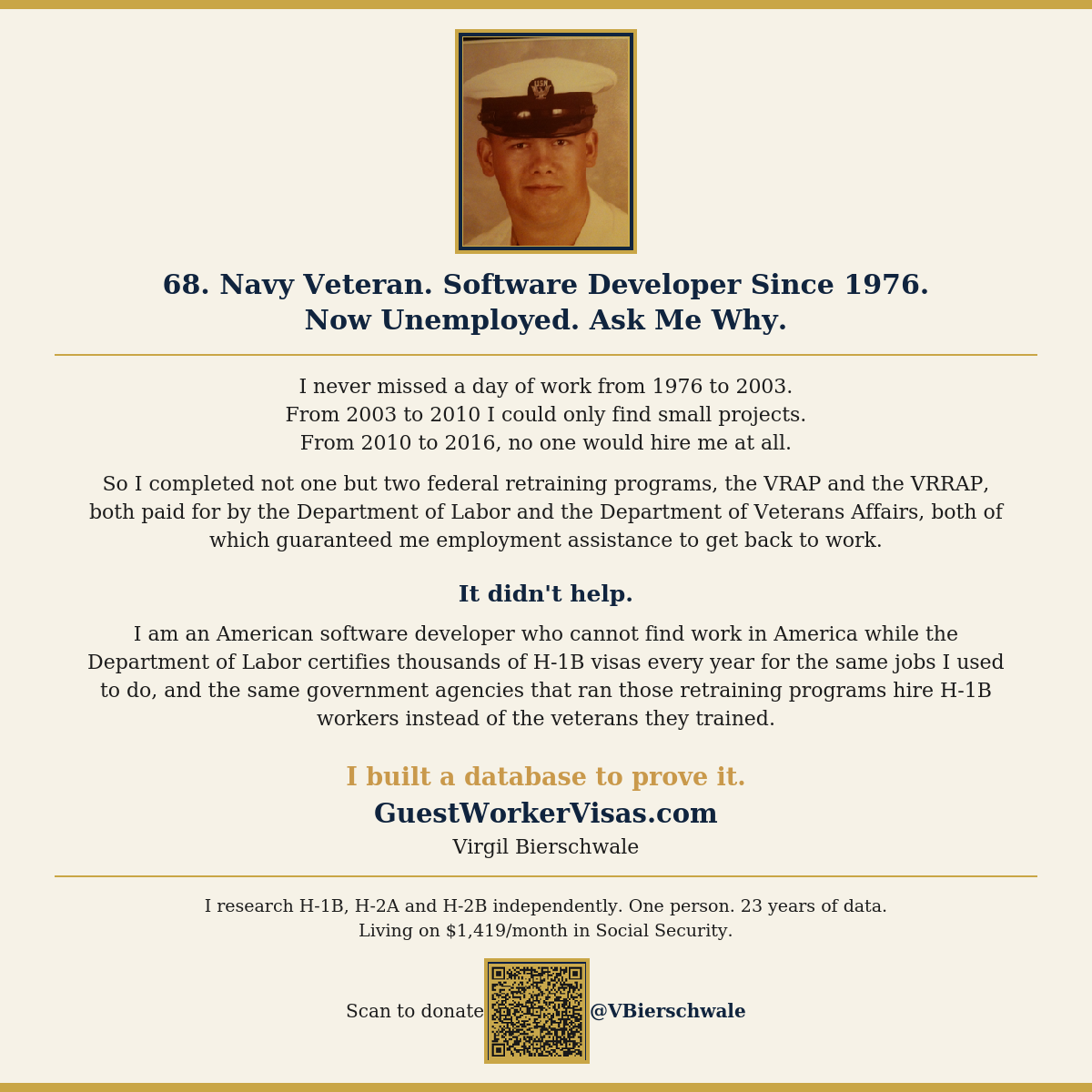
I went to work in software in 1976 and never missed a day until 2003. From 2003 to 2010, the only work I could find was small, scattered projects. From 2010 to 2016, nobody would hire me at all — not for a job I’d spent decades getting good at. I did what I was told to do: I completed two federal retraining programs, the VRAP and the VRRAP, both funded by the Department of Labor and the Department of Veterans Affairs, both of which came with a guarantee of employment assistance afterward. It didn’t help. I finished those programs and went right back to unemployment.
Here’s what I couldn’t get past: I’m an American software developer who can’t find work in his own field, while the same federal government that ran my retraining program certifies thousands of H-1B visas a year for the exact kind of job I used to do — sometimes at the very agencies that trained me.
So I built a database to prove it wasn’t just me. That database became GuestWorkerVisas.com. I’ve been researching H-1B, H-2A, and H-2B filings independently, one person, for going on two decades now. Journalist Tanul Thakur documented my story and others like it in his book Wild Wild East, and back in 2020 a writer for The American Mind, Pedro Gonzalez, interviewed me for a piece connecting my experience to Kevin Flanagan’s — Gonzalez described me, not unkindly, as feeling like the “Rodney Dangerfield” of this fight: the guy who’s been saying this for twenty years and getting no respect for it.
I bring this up not to make the story about me, but because Kevin Flanagan isn’t a one-off, and neither am I. The pattern he died over in 2003 is the same pattern that quietly ended my career the same year, and it’s the same pattern still showing up in the H-1B filings I comb through today.
The reform question buried under the tweet fight
Whatever you think of how Podhoretz or Trump Jr. framed their exchange, both of them are, in their own way, reacting to something real: a legal mechanism, still in active use, that turns severance pay into leverage for a company’s own convenience. The question worth asking isn’t who was ruder online — it’s why, more than twenty years after Kevin Flanagan died, the same disclosure gaps that let his story go unnoticed until his family and coworkers spoke up are still standing. LCA filings are public, but they’re not easy to search or connect to real outcomes, and severance agreements that condition pay on training a replacement aren’t required to be disclosed at all.
Worth noting
Not everyone who works on this issue agrees on the fix. Some economists argue the wage and displacement effects of H-1B and offshoring programs are smaller and more contested than advocates on either side claim, and that visa reform is a poor substitute for broader labor-market policy. That’s a fair empirical debate, and one we’ll keep covering with the data as it comes in — but it’s a different question from whether displaced workers deserve to see the paper trail of their own displacement. On that narrower point, the case for disclosure is hard to argue against.