Testing the “2.62 Jobs Per H-1B” Claim
An Analysis Using Actual Employment Data (1990-2024)
The Claim
“Each H-1B visa holder creates 2.62 additional jobs for U.S. workers”
This statistic originates from a 2011 study by economist Madeline Zavodny, frequently cited by the National Foundation for American Policy (NFAP). The study specifically analyzed foreign-born workers with advanced U.S. degrees in STEM fields.
The Data
H-1B Visas Issued (FY1990-2024)
Total: 4,545,134 H-1B visas
Source: U.S. Department of State, Bureau of Consular Affairs
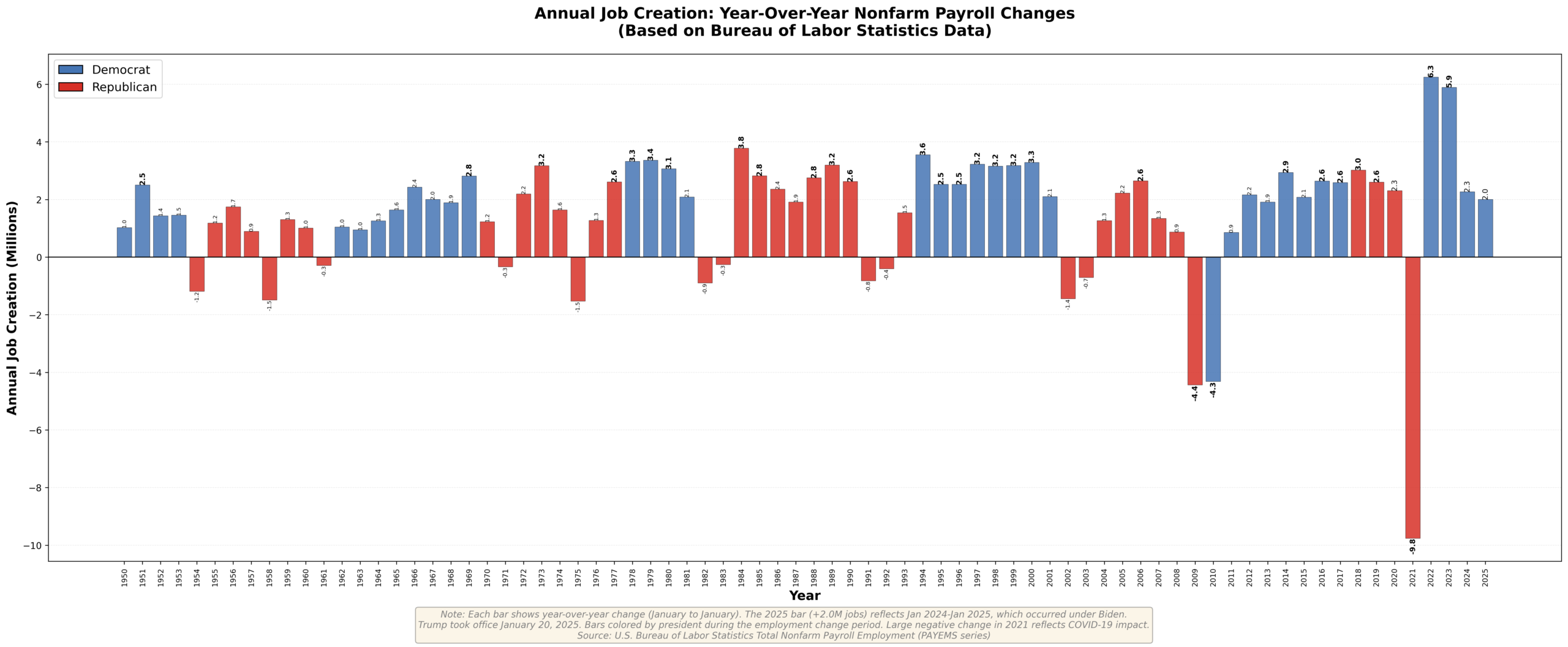
U.S. Nonfarm Payroll Employment
| Period |
Employment |
Source |
| October 1990 |
~109.5 million |
BLS/FRED |
| December 2024 |
~159.0 million |
BLS/FRED |
| Net Growth |
49.5 million jobs |
|
Source: Bureau of Labor Statistics, Current Employment Statistics
Testing the Claim
If the 2.62 multiplier were universally accurate:
Jobs “created” by H-1B program:
- 4,545,134 H-1B visas × 2.62 jobs/visa = 11,908,251 jobs
This would represent:
- 11,908,251 / 49,500,000 = 24.1% of ALL job growth from 1990-2024
The Verdict: HIGHLY IMPLAUSIBLE
The claim fails basic scrutiny for multiple reasons:
1. Attribution Problem
Attributing 24% of all U.S. job growth over 34 years to H-1B visas alone ignores:
- Population growth (251 million → 345 million Americans)
- GDP growth ($6 trillion → $29 trillion nominal)
- Technological change
- Business cycle dynamics
- Policy changes
- Consumer demand growth
- Natural business expansion
- Productivity improvements
- And hundreds of other economic factors
2. The H-1B Workers Themselves Are Counted
- H-1B visa holders are themselves employed and counted in nonfarm payroll
- So the 4.5 million H-1B visas represent 4.5 million jobs directly
- The “2.62” multiplier supposedly refers to additional jobs created
- This would mean 4.5M direct + 11.9M indirect = 16.4M jobs = 33% of all job growth
- This is economically implausible
3. Temporary Nature of H-1B Status
- H-1B is a temporary visa (3-6 years typically)
- Many H-1B holders:
- Return to their home countries
- Switch to other visa categories
- Adjust to permanent resident status
- The 4.5 million visas ≠ 4.5 million concurrent workers
- Estimated concurrent H-1B population in 2019: ~583,000 (USCIS)
- This is far less than cumulative issuances
4. The Original Study Was Much More Narrow
The 2.62 multiplier was based on:
- Only foreign-born workers with advanced U.S. degrees
- Only STEM fields
- Only S&P 500 technology companies (according to critics)
But H-1B program reality:
- Many have only bachelor’s degrees
- Not all are in STEM
- Includes outsourcing companies
- Much broader than the study’s scope
5. Correlation ≠ Causation
Even if high-skilled immigration correlates with job growth:
- Both could be caused by economic expansion
- Growing companies hire more workers (including H-1Bs)
- Growing companies also expand overall employment
- The H-1B hiring might be a result not a cause
6. Alternative Calculation with Concurrent Workers
If we use concurrent H-1B population instead:
- ~583,000 H-1B workers in 2019 (USCIS estimate)
- 583,000 × 2.62 = 1,527,460 jobs created
- This is 3.1% of total job growth (1990-2024)
- Still very high for a single visa program
- But at least mathematically plausible
What The Data Actually Shows
Job Growth Context (1990-2024)
Total growth: 49.5 million jobs
Major contributing factors:
- Population growth: +94 million Americans (+37%)
- Women’s labor force participation (peaked 1999)
- Technology sector expansion (dot-com boom, internet, smartphones)
- Healthcare sector growth (aging population, Affordable Care Act)
- Service sector expansion
- Educational attainment increases
- Housing boom (1990s-2007)
- Recovery from recessions (1991, 2001, 2008-09, 2020)
- Trade expansion (NAFTA, China WTO accession)
- Monetary and fiscal policy
H-1B program contribution: Likely positive, but modest and impossible to isolate
What We Can Say Confidently:
- ✅ H-1B workers fill specialized roles
- ✅ High-skilled immigration can drive innovation
- ✅ Some H-1B workers found companies that create jobs
- ✅ Technology sector growth (heavily H-1B dependent) created many jobs
What We Cannot Say:
- ❌ Each H-1B visa “creates” 2.62 specific additional jobs
- ❌ The effect is the same across all H-1B workers
- ❌ The effect is stable over time
- ❌ The effect is causal rather than correlational
The Math Problem
Scenario 1: Universal 2.62 Multiplier
- 4.5M visas × 2.62 = 11.9M jobs
- Plus 4.5M H-1B workers themselves = 16.4M total
- 16.4M / 49.5M = 33% of all job growth
- Verdict: Implausible
Scenario 2: Concurrent Workers
- ~583K concurrent workers × 2.62 = 1.5M jobs
- Plus 583K H-1B workers = 2.1M total
- 2.1M / 49.5M = 4.2% of job growth
- Verdict: Possibly plausible, but unprovable
Scenario 3: Reality Check
- Job growth driven by hundreds of interacting factors
- H-1B is one small component
- Effect varies by:
- Sector (tech vs. outsourcing)
- Education level
- Company type (startup vs. established)
- Economic conditions
- Geographic location
Conclusion
The claim that H-1B visas created 2.62 jobs each is NOT supported by the aggregate employment data.
Why the claim persists:
- Political advocacy: Used by pro-immigration groups
- Simplified messaging: Easy sound bite
- Cherry-picked research: Narrow study generalized broadly
- Correlation confusion: Economic growth and H-1B hiring both reflect prosperity
What we actually know:
- High-skilled immigration can boost innovation and growth
- The effect size is debatable and context-dependent
- Attributing 24-33% of all U.S. job growth to H-1B visas is economically unrealistic
- The original study’s findings don’t generalize to the entire H-1B program
- Many other factors explain the 49.5 million jobs created since 1990
Bottom Line:
The 2.62 multiplier is:
- Oversimplified (from a narrow study)
- Overgeneralized (applied to all H-1B workers)
- Overstated (when applied to cumulative visas)
- Unverifiable (using macro employment data)
The reality is far more nuanced than any single multiplier can capture.
Sources
- U.S. Department of State – Nonimmigrant Visa Statistics (1990-2024)
- Bureau of Labor Statistics – Current Employment Statistics (PAYEMS)
- Federal Reserve Economic Data (FRED) – Total Nonfarm Payroll
- USCIS – H-1B Authorized to Work Population Estimate (2019)
- Zavodny, M. (2011) “Immigration and American Jobs” – American Enterprise Institute
- National Foundation for American Policy (NFAP) – various reports
- Center for Immigration Studies – critiques of multiplier claims